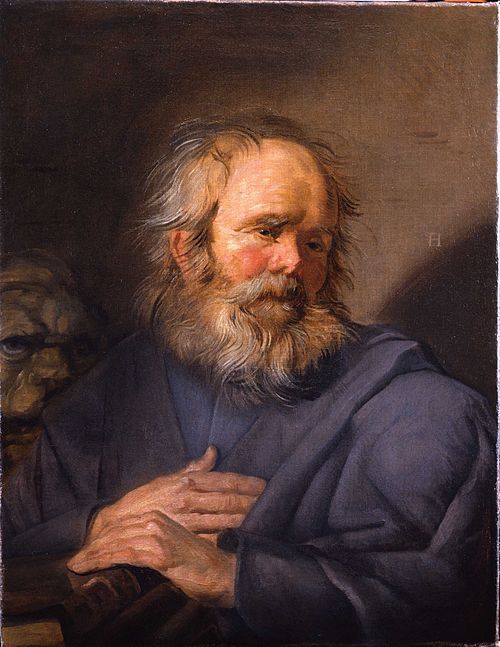
Feast of Saint Mark, evangelist

“But they went forth and preached everywhere,
while the Lord worked with them…”

There is something wonderfully reckless about the word forth.

It does not suggest careful planning.
It does not imply perfect readiness.
It simply assumes movement.

They went forth.

Close-up of vibrant red flowers with a bee on one of the blossoms, surrounded by green leaves.

Not in Latin, nor even in English—but in blossoms.

Flowers and bees are coming forth everywhere, as though the earth itself has decided to become evangelical. No committee was formed. No strategy was outlined. No one asked if the conditions were ideal.

They simply came forth.

And I, walking among them, listening to a interview of a priest I have never met, found myself confronted—not by doctrine, but by direction.

Father Ryan spoke of his own forth—how he moved from one life into another, not because he had mastered the path, but because he answered the call.

And I, being a man fond of definitions, began to analyze the word:

Forth: outward, onward, away from the starting point.

Which is precisely what I find most inconvenient.

For I prefer to remain near the starting point.
It is familiar. It is manageable. It is mine.

Yet the Gospel offers no such comfort.

Mark does not say the apostles reflected, or hesitated, or refined their message.

He says they went forth.

And here lies the quiet discomfort:

My life is full of motion—but not always of direction.

I go forth into tasks, into routines, into responsibilities…
but do I go forth into mission?

Or do I simply move in circles with great enthusiasm?

For there is a difference between movement and sending.

One is self-directed.
The other is obedience.

And so I must ask, with some seriousness:

call me forth.

I have lingered long at the threshold,
busy with preparation,
comfortable with intention.

But You do not ask for perfection—
only for response.

Give me the courage to step outward,
the humility to be led,
and the trust to believe
that You are already at work where You send me.

Do not let me confuse activity with mission,
nor motion with obedience.

Send me forth
not into greatness,
but into faithfulness.

A bearded figure in a red and gold bishop's attire, holding a staff with a cross at the top, gazes thoughtfully. The background features a soft blue sky with clouds.
St Mark by Frans Hals (1625)
Evangelist, Martyr
Born
c. 12 AD
CyreneCrete and CyrenaicaRoman Empire
(according to Coptic tradition)[1]
Died
c. 68 AD (aged c. 56)
AlexandriaEgypt, Roman Empire
Venerated in
All Christian churches that venerate saints
Major shrine
St Mark’s Basilica (Venice)
Saint Mark’s Coptic Orthodox Cathedral (Alexandria)
Feast
25 April (Catholic, Anglican Church, and Eastern Orthodox Julian calendar date)
30 Parmouti or 8 May (Coptic Orthodox and Eastern Orthodox Gregorian calendar date)
Patronage
BarristersVenice,[2] EgyptCopts,[3] MainarPodgorica,[4] Pangil, Laguna
Major works
Gospel of Mark (attributed)

There is a holy swiftness in the Gospel according to Saint Mark the Evangelist.

He wastes no time.

“Immediately… immediately… immediately…”—as though the Kingdom of God refuses to sit still long enough for polite reflection.

And this is the curious thing about Mark himself:

He was not the most prominent apostle.
He was not the loudest voice.
He even stumbled—turning back once when the journey became difficult.

And yet—he went forth again.

Chesterton would smile at such a man,
for he embodies the great paradox of Christianity:

Not the flawless hero,
but the faithful returner.

Mark goes forth not because he never failed,
but because he did not remain in failure.

And then, with a kind of divine mischief, he writes a Gospel that mirrors his own life—urgent, direct, always moving forward, as if to say:

“Do not linger where Christ has already moved.”

The world admires those who never fall.
The Gospel is written by those who get up—and go forth again.

And perhaps that is the final comfort:

The Lord works with them
not because they are perfect,
but because they are willing to go.

Even if, like Mark,
they must begin again.

Logo of the Laudato Si' Action Platform, featuring a stylized tree design with a gradient of colors, and the text 'LAUDATO SI' Action Platform' in a modern font.
Logo of Pope Francis' encyclical 'Laudato Si' featuring a globe surrounded by smiling children and green leaves.
Laudato si’ §86

Laudato si’ reminds me that creation itself is dynamic, always moving outward in praise and relationship.

Action:

Today, I will take one deliberate step forth—a conversation, an invitation, an act of witness or service that I would normally delay.

For Synodality is not standing still together—
it is going forth together.

A restless movement between past and future—but the Gospel insists on a different rhythm: not back and forth, but forth.
Men sent into uncertain terrain, carrying both courage and conflict. A reminder that going forth often reveals more about the heart than the destination.
8. Poetic Verse

The flowers broke the silent ground
without a word or plan—
they simply rose where they were placed
and did what they began.

And I, who wait for clearer signs,
and map each careful course,
am gently pressed by growing things
to trust a deeper force.

So let me leave the place I know,
and step beyond my view—
for grace is not behind me held,
but waiting forth—in You.

Leave a Reply

Discover more from Of the Glenn Enterprises

Subscribe now to keep reading and get access to the full archive.

Continue reading