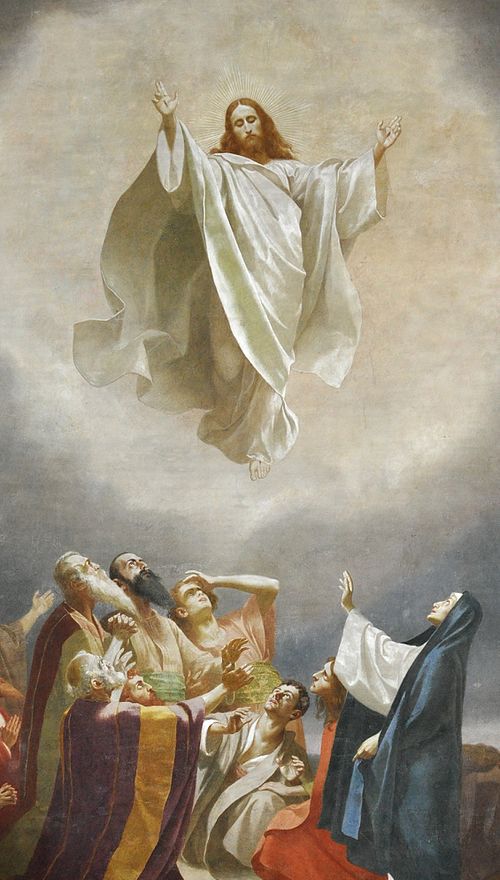
“I dealt with all that Jesus did and taught until the day he was taken up…”
— Acts 1:1–2
Gospel
“And behold, I am with you always, until the end of the age.”
— Matthew 28:20
The Ascension is one of those feasts that initially appears to be about absence, when in fact it is about a strange new form of presence. Christ goes away, yet somehow becomes more universally near. He ascends beyond sight, yet fills all creation.
The tiny word until hangs over both readings like a church bell ringing across history.
Jesus taught until the day He was taken up. Jesus remains with us until the end of the age.
The Christian life itself is an existence lived in between two untils.
2. Meditatio
The Diocese of Amarillo will celebrate its Centennial with a Mass of Thanksgiving Saturday, Aug. 22 at 10:00am at St. Mary’s Cathedral, 1200 South Washington.
How am I living this strange time called until?
Right now the Diocese of Amarillo is celebrating one hundred years of until. I am being invited to look forward to the Centennial Mass of Thanksgiving on Saturday, August 22 at St. Mary’s Cathedral. There is much language of celebration, gratitude, unity, and remembrance. And all of that is good. Anniversaries matter because memory matters.
Yet I wonder whether I resemble those Men of Galilee staring upward at the Ascension. I find myself looking intently toward August 22 as though history itself might finally arrive there complete and triumphant. And I half expect suddenly to hear two men in white garments ask:
“Why are you standing there looking toward the Centennial?”
For much of my life I have been caught in another kind of until. I have spent years asking the Diocese not merely to celebrate its light but also to acknowledge its shadows. I think of the monument raised by John Salazar, a convicted pedophile priest, for Bishop Matthiesen—a monument that still stands like an unresolved sentence in the middle of our diocesan story. I remember being told repeatedly that addressing such things would cause too much division “at this time.” Let us wait until later. Let us deal with it after the Centennial. Let us postpone sorrow in favor of celebration.
And perhaps that is the peculiar temptation hidden inside the word until: the temptation to believe that holiness can always be delayed one more season.
But the Ascension does not permit paralysis. The angels do not tell the apostles to remain gazing upward forever. Christ ascends precisely so that the Church may descend into the ordinary dust of history and begin the uncomfortable work of witness.
Chesterton once suggested that Christianity has not been tried and found wanting; it has been found difficult and left untried. That is often true not only of individuals but of dioceses, nations, and institutions. Repentance is difficult. Truth-telling is difficult. Reconciliation is difficult. And so we frequently postpone them with the most religious sounding word imaginable: until.
Yet Christ Himself transforms the word.
For Christians, until is no longer merely postponement. It is promise.
That means I do not wait alone. The Church does not stumble through history abandoned. Christ accompanies us through every awkward synod, every painful revelation, every unfinished argument, every broken institution, every half-healed wound.
And perhaps that is why the Mass remains essential to me. The Mass is where the terrible burden of until becomes bearable. At Mass Heaven interrupts history. At Mass Christ who ascended still descends sacramentally among His people. At Mass I stop merely staring nostalgically backward or anxiously forward and instead stand within eternity itself.
The Eucharist is the Church’s great rebellion against despair.
It reminds me that history is not abandoned to bureaucracy, scandal, nostalgia, or public relations campaigns. Christ remains with us until the end of the age—not until the next diocesan initiative, not until public opinion changes, not until institutions become perfect, but until the very end.
And that changes everything.
3. Oratio
Lord Jesus Christ, You ascended into Heaven yet refused to abandon the earth.
Teach me how to live faithfully in this long season called until.
When I become trapped in nostalgia, send me forward. When I become consumed with anger, grant me charity. When I become tempted to postpone truth for the sake of comfort, give me courage.
Help Your Church to celebrate honestly, repent humbly, and proclaim boldly.
Remain with us in every unfinished chapter of history. Remain with us in every wound still waiting for healing. Remain with us at every altar where Heaven touches earth.
For without Your presence, until becomes despair. But with You, until becomes hope.
The Ascension is the great paradox of Christianity: Christ departs in order to become more present.
A worldly king remains seated visibly upon his throne so his subjects may know where power resides. Christ vanishes into Heaven and leaves behind fishermen, doubters, sinners, and sacraments. By every worldly standard it is a terrible management strategy.
And yet it is precisely the strategy by which the world was conquered.
Modern man believes progress comes from escaping the past. The nostalgic man believes salvation comes from preserving the past untouched. Christianity alone insists that redemption comes from carrying the past truthfully through the Cross into resurrection.
The Church therefore lives perpetually in until. Until justice and mercy kiss. Until wounds are healed. Until Christ returns.
The danger is not waiting. The danger is confusing waiting with avoidance.
The apostles waited in prayer before Pentecost. That was holy waiting. Pilate delayed judgment to preserve political peace. That was cowardly waiting.
One until opens the soul to God. The other merely postpones conversion.
And perhaps the Ascension teaches me that the Church must learn how to look upward without refusing to look inward.
5. Actio — In Light of Laudato Si’ and Synodality
Until greater progress is made in developing widely accessible sources of renewable energy, it is legitimate to choose the less harmful alternative or to find short-term solutions.
The integral development of the person, nurtured through family relationships, can radiate beyond the home, through volunteering, working with others, serving the vulnerable, showing tenderness and patience in difficult situations, and lovingly accompanying people in need. “The strength of the family lies in its capacity to love and to teach how to love” (AL 53), 13 and this strength is manifested through giving, gratuitousness, care and responsibility towards both others and the environment
Pope Francis warned in Laudato Si’ against the “technocratic paradigm” that reduces creation to an object for manipulation rather than a gift to be received. Synodality requires that we resist becoming isolated digital consumers and instead become people capable of discernment together.
Action:
So today my action is this:
I will resist the temptation to postpone difficult truths indefinitely for the sake of appearances. I will remember that unity without truth is sentimentality, while truth without charity becomes cruelty.
Synodality requires walking together not only through celebration, but through repentance.
And I will remember that Christ accompanies His Church not only in her triumphs, but also in the painful work that must be done until the Kingdom comes in fullness.
6. Song Pairing 🎵
🎶 “The Twelfth of Never” — Johnny Mathis🎵
A song about a love stretching beyond measurable time. Its exaggerated poetry strangely echoes the Christian sense of until: a promise extending past calendars and calculations into permanence.
A story of enduring love through suffering and uncertainty. Like the Ascension itself, it explores how absence can deepen presence, and how fidelity survives even when the future remains unresolved.