“Holy Father, keep them in your name… Consecrate them in the truth. Your word is truth… And I consecrate myself for them, so that they also may be consecrated in truth.”
— John 17:11,17,19
This prayer of Christ sounds at once priestly and parental. It is not merely advice being offered from a distance; it is a man placing Himself upon the altar for those He loves. Christ does not merely command holiness; He becomes holy for us, so that holiness might become contagious.
The strange thing about Christianity is that God does not save the world by escaping it, but by entering it so completely that even bread and wine become dangerous with divinity.
2. Meditatio
To consecrate means to officially declare something holy, sacred, or dedicated to a higher divine purpose. The word comes from the Latin consecrat, meaning “associated with the sacred.” Yet I suspect the word itself now badly needs reconsecration.
Modernity has taken many sacred words and put them to work in corporate offices.
Today one hears people speak of being “consecrated” to a career, to a brand, to athletic achievement, to politics, to fame, or to “the hustle.” The word survives, but its object has shrunk pitifully. A man may now consecrate himself entirely to selling insurance software or optimizing digital advertising metrics. One almost expects Saint Paul to appear on LinkedIn.
But the Christian meaning of consecration is infinitely stranger and grander than mere dedication. Consecration does not simply mean focusing intensely upon something. It means being separated from one purpose in order to belong entirely to Another.
At Mass, ordinary bread and wine are consecrated into the Body and Blood, Soul and Divinity of Christ. The miracle is not merely that God enters the bread, but that the bread ceases to belong merely to itself. It becomes something wholly surrendered.
And then comes the more unsettling miracle: I consume what has been consecrated so that I myself may become consecrated.
The Mass does not end with me privately enjoying a spiritual experience. I am sent forth to consecrate the world—not by fleeing from creation, but by refusing to let creation become secularized beyond recognition.
That is perhaps the true battle of our age. The modern world does not deny sacred things outright nearly as often as it dilutes them into motivational slogans. We turn vocation into careerism, sacrifice into productivity, holiness into self-improvement, and consecration into ambition.
Yet while here in Missouri among fields, fences, cattle, sheepdogs, and old Catholic friendships, I have felt something reconsecrated in myself. There is something about the land that resists abstraction. Sheep do not care about branding strategies. Water troughs must still be filled. Fences still need mending. Prayer still rises at dawn.
And perhaps that is why rural life has always possessed a sacramental quality. It constantly reminds a man that the world is not raw material for consumption, but creation waiting to be blessed.
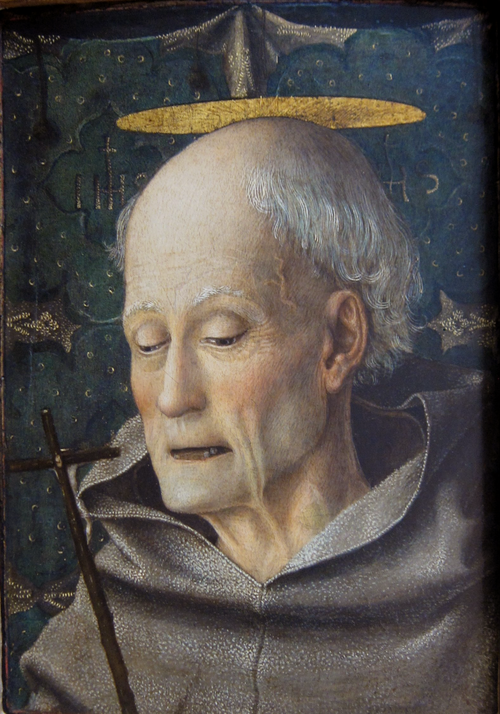
Saint Bernardine of Siena spent his life carrying the Holy Name of Jesus into chaotic cities filled with greed, factions, and noise. He quite literally held up the name of Jesus before crowds as though trying to reconsecrate language itself.
Perhaps that is my task too—not to escape the world, but to keep sacred words sacred inside it.
And perhaps the first word that must be reconsecrated is my own life.
3. Oratio
Lord Jesus Christ, You consecrated Yourself for us, that we might become holy in truth.
Take the ordinary bread of my life— my work, my friendships, my travels, my worries, my failures— and consecrate them to Your glory.
Keep me from turning holy things into slogans or sacred words into decorations.
Through the prayers of Saint Bernardine of Siena, teach me to carry Your Holy Name with reverence and joy.
May my life proclaim that the world is still filled with sacred things.
Chesterton understood that Christianity is the great defender of ordinary things precisely because it dares to call them sacred. Water becomes baptism. Oil becomes healing. Bread becomes God.
The modern world often imagines holiness as escape from material things. Christianity insists instead upon the sanctification of material things. It is not anti-world but anti-worldliness. The difference is everything.
The secular mind says matter is meaningless until humans assign it value. Christianity says matter already possesses meaning because it was spoken into existence by God.
Thus the truly consecrated man is not one who despises the world, but one who sees through it toward its Creator.
Saint Bernardine wandered through noisy marketplaces preaching the Holy Name of Jesus because he understood that civilization collapses when language itself becomes desacralized. Once words lose holiness, eventually people do too.
And so Christ prays not merely that I become informed, productive, or successful—but consecrated in truth.
That is a far more dangerous prayer.
5. Actio — In Light of Laudato Si’ and Synodality
In 1971, eight years after Pacem in Terris, Blessed Pope Paul VI referred to the ecological concern as “a tragic consequence” of unchecked human activity: “Due to an ill-considered exploitation of nature, humanity runs the risk of destroying it and becoming in turn a victim of this degradation”.[2]
The Apostolic Exhortation Gaudete et Exsultate stresses that “growth in holiness is a journey in community, side by side with others.” This is why, in marriages, “each spouse becomes a means used by Christ for the sanctification of the other” (GE 141).
Pope Francis reminds us in Laudato Si’ that creation is not an object to exploit but a gift to receive with reverence. Today I will intentionally treat one ordinary object, task, or encounter as sacramental rather than utilitarian.
Action:
Whether feeding animals, sharing a meal, praying the Rosary, or speaking with a friend, I will consciously remember that holiness enters the world through ordinary things offered back to God.
Synodality calls me not merely to preserve sacredness privately, but to help others rediscover it together.
6. Song Pairing 🎵
🎶 “My Shot” — Hamilton 🎵
A song about ambition, destiny, and refusing to waste one’s opportunity. Yet the Gospel quietly transforms the idea of “not throwing away my shot” from self-advancement into self-offering. The Christian does not consecrate himself to fame, but to fidelity.
7. Movie Pairing 🎬
Consecration (2023)
A haunting meditation on faith, mystery, sacrifice, and the unsettling realization that sacred things are never merely symbolic. Consecration changes reality itself.