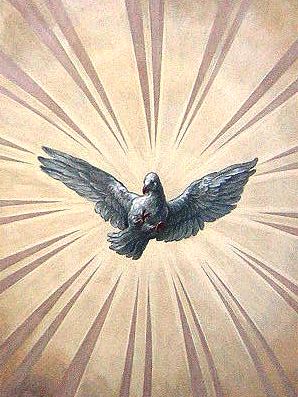
On the evening of that first day of the week, Jesus came and stood in their midst and said to them, “Peace be with you.”
And when he had said this, he breathed on them and said to them,
“Receive the Holy Spirit.”
— John 20:22
The Gospel does not begin Pentecost with fireworks but with breath. Not with armies marching through Jerusalem, but with frightened men hiding behind locked doors while God quietly exhales upon them.
This breath recalls the first breath in Eden, when God bent over dust and made Adam alive. The Church, too, begins not as an institution but as resuscitation. Christianity is God breathing into frightened humanity until fear itself becomes proclamation.
2. Meditatio
Breathed upon. How can something so small alter the whole world?
I am conditioned to believe that only large events matter: coliseums, centennial celebrations, overflowing crowds, grand announcements, commemorative banners, and carefully managed spectacles. It was recently announced that the Diocese of Amarillo’s Centennial Mass of Thanksgiving on Saturday, Aug. 22 has been moved from St. Mary’s Cathedral to the Cal Farley Coliseum at the Amarillo Civic Center because the Cathedral is no longer large enough to contain the crowd. All other Masses that morning throughout the Diocese are cancelled so that this may become the single Mass during the day.
And yet Pentecost itself began in a locked room.
The Church that now requires a coliseum once fit inside an upper room full of cowards.
That fact comforts me and troubles me simultaneously.
For I find myself asking whether the Spirit is always most present in largeness. Christ did not breathe upon the disciples from a stage. He breathed upon them at close range, personally, quietly, intimately — so near they could probably feel the warmth of His breath upon their frightened faces.
Meanwhile I find myself still wounded by the refusal to confront darker things within our diocesan history — such as the tribute raised by a convicted pedophile priest for Bishop Matthiesen, who publicly expressed no regret for having granted that priest another opportunity to abuse minors. And so I hear Christ’s words about forgiving sins and retaining sins, and I do not know entirely what to do with them.
There are sins forgiven because repentance has broken the heart open to grace. And there are sins retained because silence has sealed the wound shut.
Perhaps what troubles me most is not that the Church has sinners — for Pentecost itself began with Peter, who denied Christ three times — but whether we are willing to let the Holy Spirit breathe honestly into the wounds instead of covering them with celebratory banners.
Still, the Gospel reminds me that the Spirit does not wait for perfect rooms before entering them. If He waited for purity, He would never have entered the upper room at all.
And perhaps that is the true scandal of Pentecost: that God continues breathing into broken men and broken institutions until dry bones rise again.
3. Oratio
Lord Jesus Christ, You who breathed life into dust and courage into frightened disciples, breathe again upon me.
Breathe into the places in me sealed shut by bitterness, disappointment, cynicism, and woundedness. Breathe into Your Church where fear has replaced truth. Breathe into our Diocese where celebration and sorrow now strangely stand beside one another.
Teach me neither naïve triumphalism nor despair, but truthful hope.
Let Your Spirit disturb what must be disturbed. Let Your Spirit heal what must be healed. Let Your Spirit expose what must no longer remain hidden.
And when I am tempted to think only grand gestures matter, remind me that the salvation of the world once entered history as quietly as breath.
We assume that whatever is loud must also be important. We believe salvation arrives through amplification systems, strategic plans, civic centers, and publicity campaigns. Yet God continues His habit of changing history through things almost absurdly small: bread, wine, water, oil, words, and breath.
The Holy Spirit is invisible precisely because He is essential. One may ignore breathing for several seconds; one cannot ignore the lack of it for long.
And this is why the Church survives even her scandals and foolishness. If Christianity were merely human, it would have collapsed centuries ago under the weight of her own clergy, committees, and catastrophes. The miracle is not that the Church has sinners. The miracle is that the Spirit continues breathing through sinners at all.
Pentecost therefore is not optimism. It is resurrection respiration.
5. Actio — In Light of Laudato Si’ and Synodality
We have forgotten that we ourselves are dust of the earth (cf. Gen 2:7); our very bodies are made up of her elements, we breathe her air and we receive life and refreshment from her waters.
In conclusion, the journey towards holiness within a family can help to address the origins of the ecological crisis, since “we cannot presume to heal our relationship with nature and the environment without healing all fundamental human relationships” (LS 119).
In Laudato Si’, Pope Francis reminds us that creation itself is sustained by the breath of God, and that authentic ecology begins with learning again how to receive life as gift rather than possession. Synodality likewise requires listening — and listening requires breathing room.
Action:
Today my action is to create space for the Holy Spirit rather than noise for myself.
That may mean:
listening before reacting,
telling difficult truths without hatred,
refusing both denial and despair,
or simply stepping outside at dawn and remembering that every breath is borrowed from God.
The Spirit is not manufactured by institutional success. The Spirit is received.
And perhaps the Church most resembles Pentecost not when she fills coliseums, but when she dares once more to breathe honestly.
6. Song Pairing 🎵
🎶 “The Air That I Breathe” — The Hollies 🎵
Pentecost reminds me that the most necessary things in life are invisible. The Holy Spirit is like breath itself: unnoticed until absent, sustaining everything while demanding no applause.
7. Movie Pairing 🎬
Breathe In (2013)
A film about emotional longing, disruption, and hidden interior lives. Pentecost similarly invades locked rooms and unsettles comfortable illusions, forcing hearts to confront what they truly desire.