


LECTIO — I Read the Word

Zacchaeus, small in stature but large in longing, climbs a sycamore tree simply to see Jesus.
Jesus stops beneath that tree, looks up, and calls him by name.


A man once consumed by wealth becomes, in a moment, generous beyond measure.
A man once lost is found.
A house once burdened becomes a place where salvation enters.

James warns that clinging to wealth corrodes the soul—the rust of selfishness becomes a fire that eats the heart. John echoes: if we see a brother in need and do nothing, how can God’s love abide in us?
Dilexi te §30
MEDITATIO — I Let the Word Read Me
The word that rises for me today is transformation.

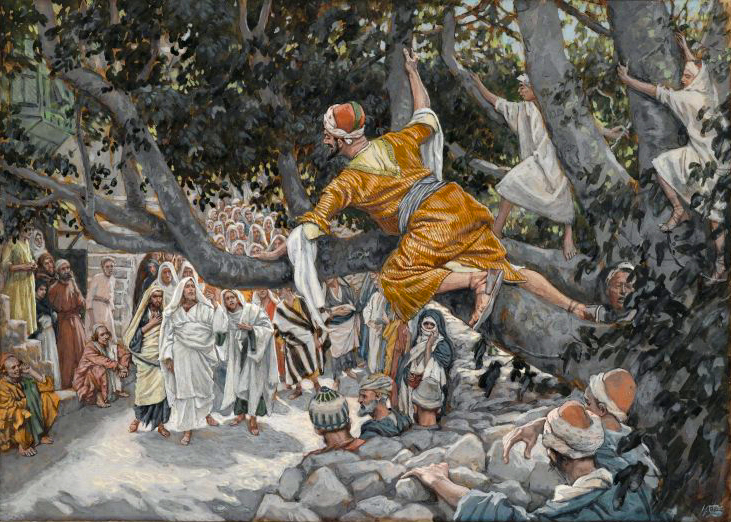
Work by James Tissot
Like Zacchaeus, I too have climbed my own “trees” just to catch sight of Christ passing by—because I was tall in self-righteousness and simply could not see Him from where I was standing.

And today, as I looked at the brown oak leaves plastered to the chain-link fence, held there by the relentless autumn winds, I realized they were the same leaves I admired just days ago—fiery red, golden, copper-bright.
Now they are dead, wind-blown, waiting to become soil again.
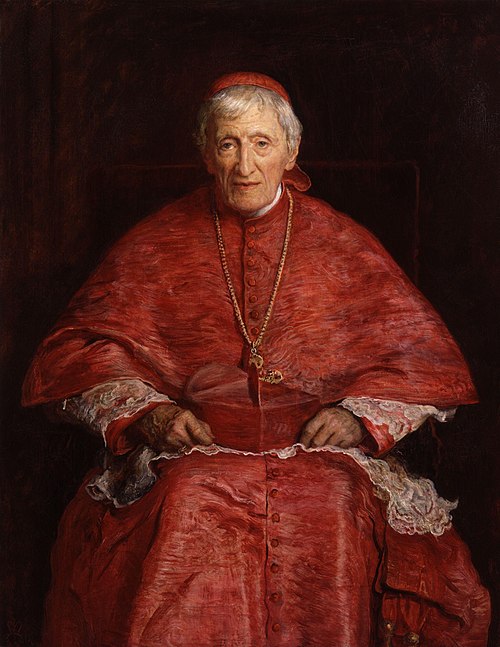
This is our faith — not static preservation, but living development.
St. Cardinal John Henry Newman, Doctor of the Church, called it Catholicity — growth that remains the same in essence, yet unfolds in fullness.

And here my prayer turns toward Bishop Strickland.
It seems to me he longs to keep the tree as it was — brilliant, intact, unmoved — unwilling to let doctrinal leaves fall according to the Church’s living rhythm.
But that is as impossible as gathering the leaves from the fence and placing them back on their branches.
Even if we tried, they would no longer be alive.

Doctrine develops.
The Church breathes.
The Spirit moves where He wills.

I pray Bishop Strickland may someday see, as Zacchaeus did, that coming down from the heights of certainty can be the very thing Christ uses to bring salvation to one’s house.
And yes — I continue to pray that his zeal might yet find a healed expression in Amarillo, helping our diocese rise from the wounds of its past clergy abuse, transforming victims into survivors… and survivors into healers.
If Boston is the fault line of the child sexual-abuse scandal that has convulsed the Roman Catholic Church, then few places have felt the aftershocks more deeply than the Diocese of Amarillo.
New York Times
A NECESSARY INSERTION — Leaves and the Wounds of 2018
And I cannot reflect on leaves—on what falls, what sticks, what resurrects—without remembering my own story in 2018.


Bishop Zurek stood before us and said he could not comment on the Philadelphia Grand Jury Report because he “did not have any facts.”
And yet, at that very moment, local news was reporting that a priest named in that same report—one who raped children—had been sent to the Diocese of Amarillo.

The leaves were already falling.
The wind was already howling.
But instead of helping us gather the broken pieces and become survivors, I was met not with accompaniment but with exclusion.
When I pressed for accountability, when I begged for transparency and healing, Bishop Zurek wrote another letter—this time naming me as not among the “faithful and loyal disciples the Lord Jesus desires.”
And in that moment, I felt the same cold wind that throws the leaves against the fence, plastering them there—stripped, exposed, abandoned.

“In memory of the death of innocence of the victims of clergy sexual abuse. When innocence dies…a life stops. It is essential that we never forget.“
But if even dead leaves become soil…
then I must believe that even this painful chapter can become something that nourishes the Church’s roots.
I must believe that healing is possible—not only for me, but for Bishop Zurek, for Bishop Strickland, and for every soul wounded in the long shadow of clerical abuse.
ORATIO — I Respond to the Word

Lord Jesus,
Give me the courage of Zacchaeus —
to climb when I cannot see You,
and to come down when You call my name.
Unbind my grasp on what no longer brings life.
Teach me to trust the seasons of Your Church —
its autumns, its springtimes, its falling leaves, its rising sap.
And in Your mercy,
heal those who resist the movement of Your Spirit
out of fear, zeal, or woundedness.
Call all of us — bishops, priests, laity —
to the table where healing begins
and communion is restored.
CONTEMPLATIO — I Rest in the Word
Like Zacchaeus, I am learning to come down from my tree.
To let Christ stay in my house—messy as it is, wounded as it is.
To trust that salvation is not a moment but a movement.
And in this movement, the falling leaves, the rust of gold and silver, the call to justice—all whisper the same truth:

Transformation is the work of God,
but courage is the work of the disciple.
ACTIO — I Live the Word

“We are called to accept the world as a sacrament of communion,
— Laudato Si’ §9
a way of sharing with God and our neighbors on a global scale.”
Today I will reach out—honestly, humbly, without fear—
to someone who is still caught in the branches or plastered to the fence,
someone who feels discarded by the Church or crushed by its failures.
I will offer presence.
I will offer listening.
I will offer the dignity every child of God deserves.
Because the Son of Man still comes to seek and to save what was lost.
And today, He begins with us.
