“…there is no one who has given up house or brothers or sisters or mother or father or children or lands for my sake and for the sake of the Gospel who will not receive a hundred times more now in this present age… and eternal life in the age to come.”
— Mark 10:28-31
“Each generation inherits the task of shaping its own era…”
The Gospel speaks not only of eternity, but of this present age. Christ does not merely promise heaven later; He promises that discipleship changes how one lives now. Yet every age imagines itself uniquely enlightened while simultaneously inventing new towers of Babel. Every century believes it has finally mastered humanity just before discovering it has forgotten what humanity is for.
2. Meditatio
I will begin using these Lectio Divinas to slowly work through Pope Leo’s Magnifica Humanitas. That itself feels strangely fitting, because I compose these reflections while using artificial intelligence, and I desire to form my conscience rightly regarding the tools I place in my hands.
Every age has its temptations. Medieval man was tempted to worship power. Industrial man was tempted to worship machinery. Modern man seems tempted to worship information itself, as though possessing infinite data were the same thing as possessing wisdom.
And yet Christ does not condemn an age merely because it invents tools. A plow may cultivate wheat for the Eucharist or for greed. A printing press may spread the Gospel or propaganda. Artificial intelligence may deepen reflection or flatten the soul into a machine that consumes words without wonder.
The danger of our age is not that we have become too intelligent, but that we risk becoming less human while congratulating ourselves on our advancement.
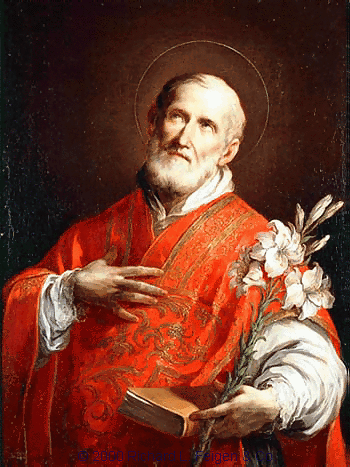
This is why Saint Philip Neri feels so necessary today. Philip lived in an age obsessed with grandeur, politics, corruption, and intellectual prestige, and his response was laughter, joy, humility, and friendship. He wandered the streets of Rome speaking to ordinary people as though holiness were not a theory but a festival. He reminds me that sanctity does not come from winning the age, but from remaining human inside it.
I suspect that is why Christ promises “a hundred times more” in this present age. The Christian life enlarges humanity instead of shrinking it. The saints are not less alive than ordinary men, but more alive.
And perhaps that is my task with AI and technology: not merely asking whether it is efficient, but whether it helps me remain fully human before God.
3. Oratio
Lord Jesus Christ, You entered history not as an abstraction, but as flesh and blood within a particular age.
Keep me from becoming cynical about the age in which I live, yet also preserve me from worshiping it.
Teach me to use every tool with humility, every invention with wisdom, and every word with charity.
Through the intercession of Saint Philip Neri, grant me a joyful heart amid anxious times, a playful spirit amid seriousness, and a humanity large enough to welcome others.
May I never confuse information with wisdom or cleverness with holiness.
And when this present age passes away, bring me safely into the age to come, where every fragment of truth is fulfilled in You.
Chesterton would have adored Saint Philip Neri because Philip understood that joy is not an ornament of Christianity; it is evidence of it.
The modern world often imagines holiness as something grim and efficient, like an especially organized committee meeting. Philip Neri shattered that illusion simply by being hilariously alive. He wore absurd clothing at times, shaved off half his beard to mock vanity, and interrupted pomposity with laughter. Yet beneath the humor was a terrifying seriousness about eternity.
Indeed, only saints can truly laugh at the world because only saints are not enslaved by it.
Every age constructs its Babel. Ours builds digital towers reaching not into heaven but into endless streams of information. We possess more knowledge than any civilization before us and perhaps less certainty about what man actually is.
Yet Christianity stubbornly insists that humanity is not fulfilled by becoming machine-like, but by becoming saint-like.
Saint Philip Neri would likely tell us that if artificial intelligence ever succeeds in perfectly imitating humanity, the proper Christian response may simply be to become more human still: more merciful, more joyful, more sacramental, more capable of wonder.
The age to come begins whenever a soul chooses holiness over mechanism.
5. Actio — In Light of Laudato Si’ and Synodality
Centuries later, in another age of trial and persecution, when the Roman Empire was seeking to impose absolute dominion, the faithful would once again find consolation and hope in a growing trust in the all-powerful God: “Great and wonderful are your deeds, O Lord God the Almighty! Just and true are your ways!” (Rev 15:3).
Everyone, each according to his or her own situation, has a meaningful contribution to make. In themselves, technical remedies to environmental and social challenges will never suffice. It is necessary to address the root causes of the problems we face, including our way of thinking about them. To this end, considering things from a genuinely human perspective is crucial: “There are no lasting changes without cultural changes, without a maturing of lifestyles and convictions within societies, and there are no cultural changes without personal changes” (LD 70). It is no surprise that the Exhortation emphasizes the growth of each person and the future of children (cf. LD 38, 58) – areas in which the family can play a leading role.
In Laudato Si’ Pope Francis warns against the “technocratic paradigm” that reduces creation and humanity into objects for manipulation.
Action:
Synodality means walking together as human persons, not merely interacting as digital profiles. I will intentionally seek one face-to-face conversation today that is unhurried, attentive, and fully human.
And I will continue these Lectio Divinas not as a technological experiment, but as an attempt to consecrate technology toward contemplation rather than distraction.
Every age thinks it is ushering in a utopia. Christianity alone dares to say the true “Age of Aquarius” arrives not through cosmic alignment or technology, but when grace lets the sunshine of heaven into the human heart.
Even in an ice age, unlikely companions become a family. The Gospel promises that whoever gives up houses or lands for Christ receives “a hundredfold” in return — because Christianity melts strangers into communion.
8. Poetic Verse
Each age erects its shining tower And bows before its newest power Yet saints still laugh beneath the sun As Philip did through streets of Rome
The tools may change, the soul remains Still wandering through joys and pains Till every age at last shall cease And restless hearts come home in peace.